
Does AZIE Exist?
Plus: a perfect rap song out of San Diego, and the triumphant return of Rosco P. Coldchain, one of the best rappers working today.

One of the great pleasures of going down a music rabbit hole online is when you come across an artist who is—or at least seems to be—on the cusp of something big. There’s no exact science to this, and sometimes a brilliant track I hear at, say, 1:30am on a Tuesday night, loses some of its magic in the light of day. Other times, you can feel a shadowy major label’s fingerprints all over something that sounds still-scrappy, still untouched. It’s gotten easier to deduce this kind of involvement since TikTok became a thing. If you keep getting fed an artist you’ve never heard of out of nowhere, is it just the self-confirmation bias of the algorithm or is a major label injecting some big bucks into the social media ecosystem to simulate the act of discovery?
In the last year or two, a new wrinkle has entered into the equation: is the song I’m listening to AI? Or partly AI? Is the artist even real? Where being mysterious was once a viable marketing campaign, sometimes it can just seem like maybe a real life flesh and blood human is actually a nonexistent digital avatar. I had this thought while, over the course of a couple days, after having it fed to me on TikTok, I couldn’t find very much (any) info about the Atlanta artist AZIEDOESN’TEXIST.
AZIEDOESN’TEXIST joined YouTube in January 2026 and she has uploaded ten videos since then—including the excellent “Everglades,” which I’ll get to in a second. In most of her videos, with a couple exceptions, she’s alone. A braces-clad, mall goth weaving a laconic, disaffected rap flow into fuzzed out slacker rock loops. She has five posts on her Instagram, under the username agirlthatdoesn’texist_, including a tour announcement. She follows no one. All her songs to date sit in the same zone: unrequited love, a deep melancholy that she owns wholeheartedly, and a flow that sounds almost deadpan and flat that she speeds up and then stops abruptly when she wants to end a line. “Everglades,” is, I think, built on a sample from the great bummer Alice in Chains track “Nutshell” and is centered around lyrics about unrequited love that are so rudimentary that they shouldn’t work at all, but AZIE sells them by sounding so bummed out, so down, that you believe, at least briefly, that this lost love is her whole world: She’s weirdly charismatic—otherwise she wouldn’t be able to sell blunt lines like “hey, I hope you doing good, I know you don’t care for me, but sometimes I just wish you would”—but also curiously affectless. There’s a “live” version of “Everglades,” that features AZIE standing on an overpass, performing the song, face pierced, eyes squinting against the sun. It sounds exactly the same as the recorded version—is probably the recorded version dubbed over the live footage. At one point I found myself counting her fingers to make sure this wasn’t extremely advanced AI. Then a train went by underneath her.
I think it’s worth clarifying that while I am very much anti AI music, I am not anti what is happening here, which appears to be an artist who has absorbed the crushing weight of being alive in America right now, and paired it with a style that is deeply informed by a flat affect that the internet—long before AI—has promoted. AZIE probably writes in all lowercase. AZIE has never written a sentence that ends in an exclamation point. In a different time AZIE would be obsessed with fairies and a pre-disgraced Neil Gaiman. Do I think that AZIE is actually not real? No, but I believe she’s at home in the uncanny valley, and that’s a weirdly fascinating place to make a career.
Shout out Andrew Noz for his monthly rap mixes, and more specifically the “new rap music april 2026” edition, which features San Diego(!)’s own SieteGang Yabbie’s 2024 track “Inner Gircle,” which just got an official video a couple weeks ago. The track is excellent. It’s immediately clear that Yabbie is a California rapper, his voice has that west coast twang, and he enunciates his syllables just enough to the point that the general geography is undeniable, but there’s a touch of the Bay here too: Yabbie has a habit of speeding up the beginning of each line, before letting his voice draw out into a more relaxed flow, or spacing out each word for maximum impact. At points he briefly sounds like E-40 circa In a Major Way, or an angry DJ Quik. I have not heard another SieteGang Yabbie song I’ve liked as much as “Inner Gircle,” but I listen to that one so frequently, I may not need to.
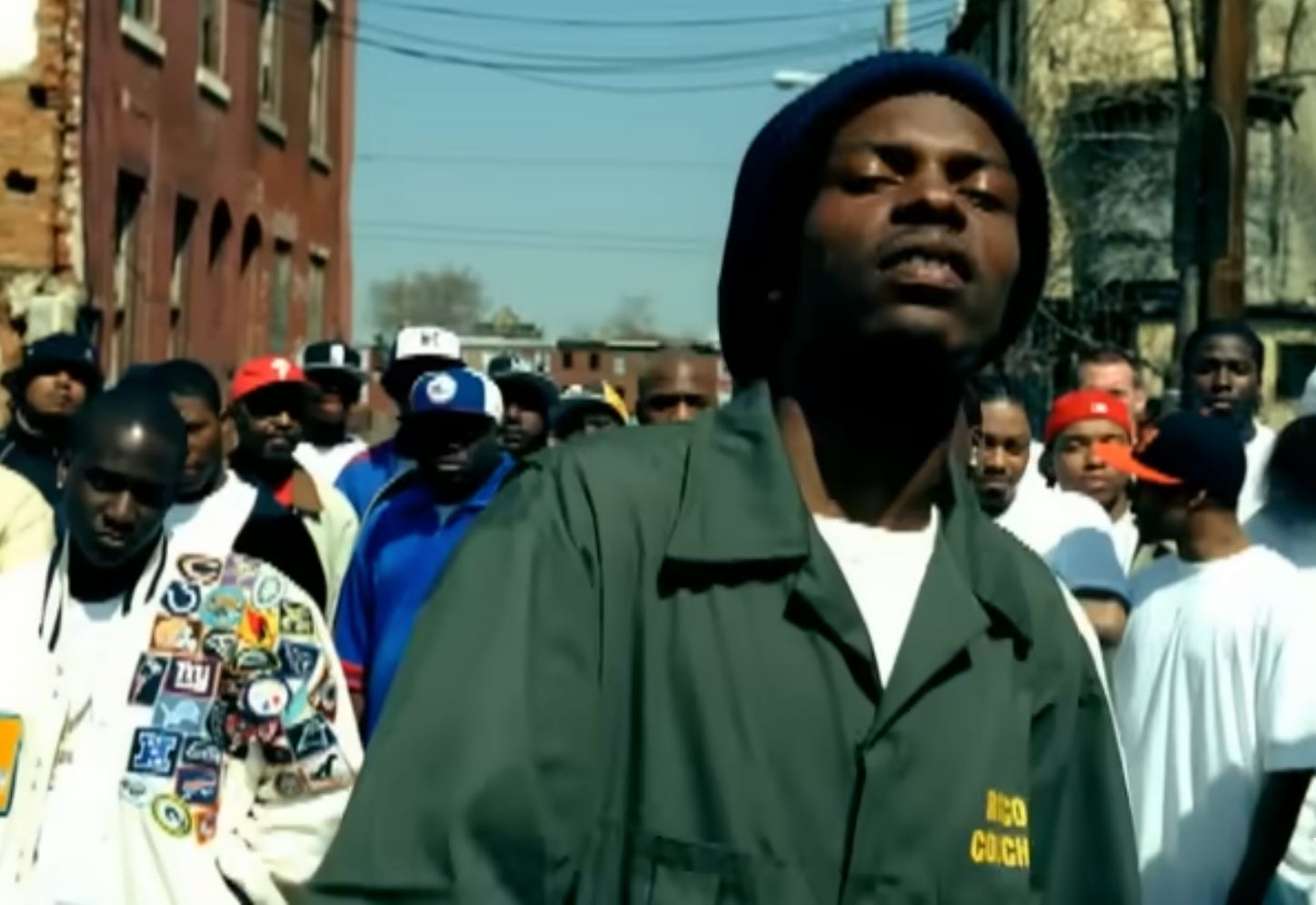
The first time I heard Philadelphia’s Rosco P. Coldchain was the first time a lot of people heard Rosco P. Coldchain. I’d obsessively followed The Clipse from their breakout Lord Willin to the unexpectedly strong Neptunes compilation The Neptunes Present…Clones, which brought a whole host of rappers into the Neptunes’ synthetic world in a way that felt truly, truly like the future. Rosco P. Coldchain appeared on “Cot Damn,” which became “Hot Damn” to make it more radio friendly. The song appeared on both Lord Willin and …Clones, but …Clones also had “Hot,” another star turn for Coldchain over a beat that sounded like a turntable being eaten by a robot. The video for “Cot/Hot Damn” was a semi-political meditation on police violence, shot through with scenes from crumbling drug spots. Coldchain didn’t quite seem to fit in with the retrofuturistic world Pharrell and Chad Hugo had been building, but that’s part of what made him fascinating. His voice, craggy, pained, the product of hidden conflict, would have sounded amazing over a vintage soul loop, but at the time that wasn’t music he was making.
Over the next few years he’d pop up here and there, but not nearly enough. I remember thinking that his verse on Clipse’s “Chinese New Year” would herald a turning point for him. Maybe he’d finally release a solo album. Maybe those loose tracks on his Myspace page were part of a larger project. And hadn’t he been working with DJ Premier? The signs were all there. I pitched my boss on a profile of him. She said yes. I started to take notes. Then Rosco got locked up for 15 years. The profile never happened.
He’s out now, and just recently released Play With Something Safe, a collaborative LP with the producer Nicholas Craven, who specializes in hard-nosed beats built on warm soul samples, aka the music that I always imagined Rosco P. Coldchain would sound good on. The good news is: he absolutely does. This is the kind of hard living reality rap record that burrows deep into your soul. It’s unflinching, both as a survey of his surroundings and his own actions. Coldchain does not shy away from self-reflection. On the deceptively upbeat “Boogie Nights”: “This is my reintroduction with a clean slate / Incarceration the reason I strayed from the rap game / In a strange way I cared what the people said / Didn’t want them to think I was better than them and so I stayed in North Philly / Nobody says get away / Nobody said this ain’t the place for you to be / you know why? / because misery loves company / I realized bullets don’t respect tough guys / pride plus arrogance equals jail time.” It’s a concise rundown of where he’s been for the last decade plus, taking into account the weird liminal state where you’re appearing on major label records, but still trapped in your own life because it’s the engine for your art, but also because it’s what you know.
Over the years, I’ve watched previous generations of rappers worry about how to navigate getting old in a relatively young genre that prides itself on innovation and youthful brashness, Coldchain’s voice, his documentary approach to the violence in his own life, the stories he’s amassed are basically a skeleton key for how to do it. I hope he’s still making albums when he’s 80. Play With Something Safe is a classic.