
New Environments 16: Firework
Tyrant, tyrants, music as memory, late-night bummer jams, and more.

After Giancarlo DiTrapano, the founder of Tyrant Books, died in 2021, I panicked. I didn’t know him beyond a couple brief exchanges online, but I loved Tyrant Books and I loved his ethos about publishing and I loved the books he published and even when I didn’t, I still sort of did because I got what he was going for and why he wanted to publish it.
I panicked because I didn’t have all the books Tyrant had published and I wasn’t sure if they’d stay in print. Something about this felt gross to me, at least for a little while. But then I realized this was an accurate reflection of the nonexistent relationship I had with this person: I didn’t know him, but I knew his work. My relationship to him was as a consumer, so consume I did, filling in the holes in my collection.
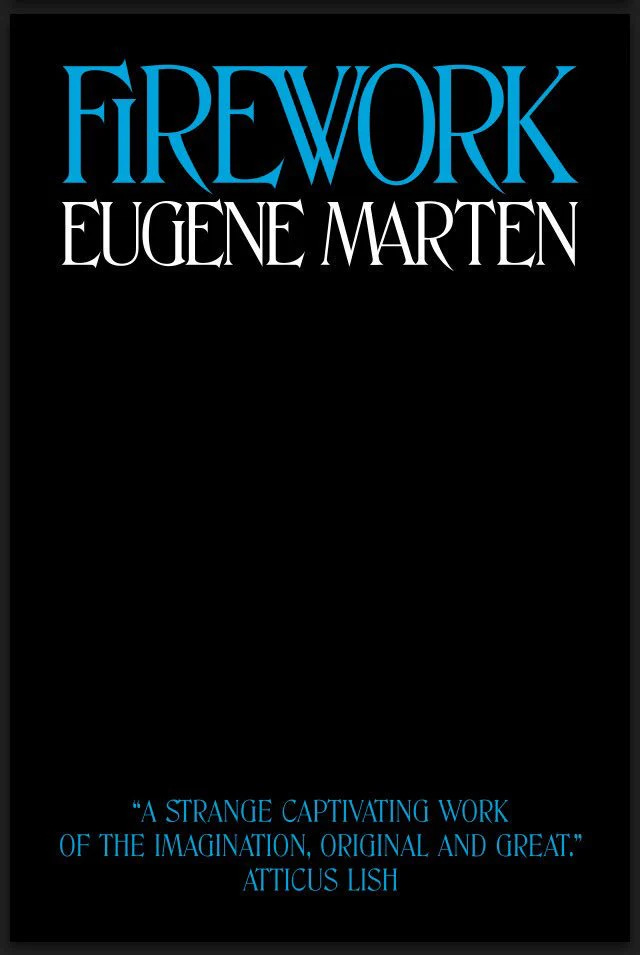
Tyrant Books lends credence to the idea of publisher as curator—of trusting the publisher the same way you’d trust a record label to release the shit you are interested in and put you in good company. Steve Anwyll’s Welfare is a singular document about the difficulties of poverty. Scott McClanahan’s books for Tyrant and elsewhere cemented him as a great American voice. More people should be reading him all the time. Atticus Lish’s Preparation for the Next Life is about war and heartbreak and coming home to a world you don’t understand. Now I read the Tyrant Books I haven’t yet read like I’m saving them up to take me through the apocalypse (and I kind of am!). Just the other day, I read Eugene Marten’s Firework, a classic novel by, I’m just going to say it, the most underrated writer currently writing.
Marten’s work is not easy, and it is frequently very disturbing. His books tend to center on characters who exist on the margins of society. Mundane men with fucked up secrets. Mundane men who are pushed through life, unable to control what happens to them. Always reacting. Rarely initiating—at least until they’re driven to do something that is usually terrible. That’s certainly the case in Firework, which is about a guy named Jelonnek who is pushed from work to jail to work to a wedding to a quick errand with a sketchy character that blows up his whole life and sends Jelonnek on a cross-country journey with a woman and her daughter that he seems to regard with intense purpose and extreme apathy, depending on the day and situation. I can’t get too deep into the plot—the errand he goes on is a seismic moment in the novel, shifting it from one type of book into something very different. The last thirty or so pages are also shocking, destructive and pivotal, but in a different way. My impulse is to say that Jelonnek is neither good nor bad, just complicated, but he’s actually not even that complicated. By the end it’s clear that whatever he may be, he is mostly just lonely.
You get older and your old friends become conspiracy theorists. They get too into numerology and then you wonder what happened and how they got there and you realize that the world is simply too harsh for them to wrap their brains around as it currently is. We probably all have a breaking point, it’s a miracle that we’re not all there yet. In the face of an information-dense way of being that doesn’t so much provide answers as toss facts and lies into a simmering pit with equal fervor, we’re left with only what we can be certain of, and then maybe eventually for some of us or more of us than we think, that goes too. War is an information destabilizer. In order to justify war, violence has to seem like the only option, and for it to seem like the only option, our governments go out of their way to create a narrative that makes everything seem complicated, even when it’s simple. If violence can never be the answer, then for our government, violence is the only answer. This causes us to lose not only facts, but also individuation. A list of casualties is not a stand-in for a life.
In 2022, the Manchester-based, Tehran born artist Parham Ghalamdar pulled audio from his parents’ collection of home VHS tapes—made when owning a VHS player was illegal—and created an album of amateur folk songs, pop songs, and moments of intimate life. It’s called Beautiful Apparitions and it’s an album in a loose sense, but more than that it’s vital because of what it does: it preserves a moment of culture—a small one, but a moment nonetheless. At points you can hear the buzz of the camera microphone straining to pick up all the audio. A whoop or a clap bringing it into the warbly red.
If you so choose, at this very moment, you can pay thirty New Zealand dollars for two songs on a 7” lathe. The economics of this, especially if you are not in New Zealand, are not ideal. In the time since I first heard Roy Irwin’s “The Comedian,” late at night, hours deep into a Bandcamp deep dive (it’s sort of like going digging at the record store but you do it from a chair in your house), I’ve considered buying it so I can hold on to this song’s isolated, bummer magic. Listeners might catch a hint of Elliott Smith’s depressive bedroom pop, and that’s a fair comparison, but this track is its own thing, too. Irwin’s pain sounds almost mundane—a guy going through life, unable to figure it out, wishing he could afford going to therapy twice a week. Relatable!